
What Does a Tick Bite Look Like? Symptoms, Timeline & Warning Signs (Weston, MA Guide)
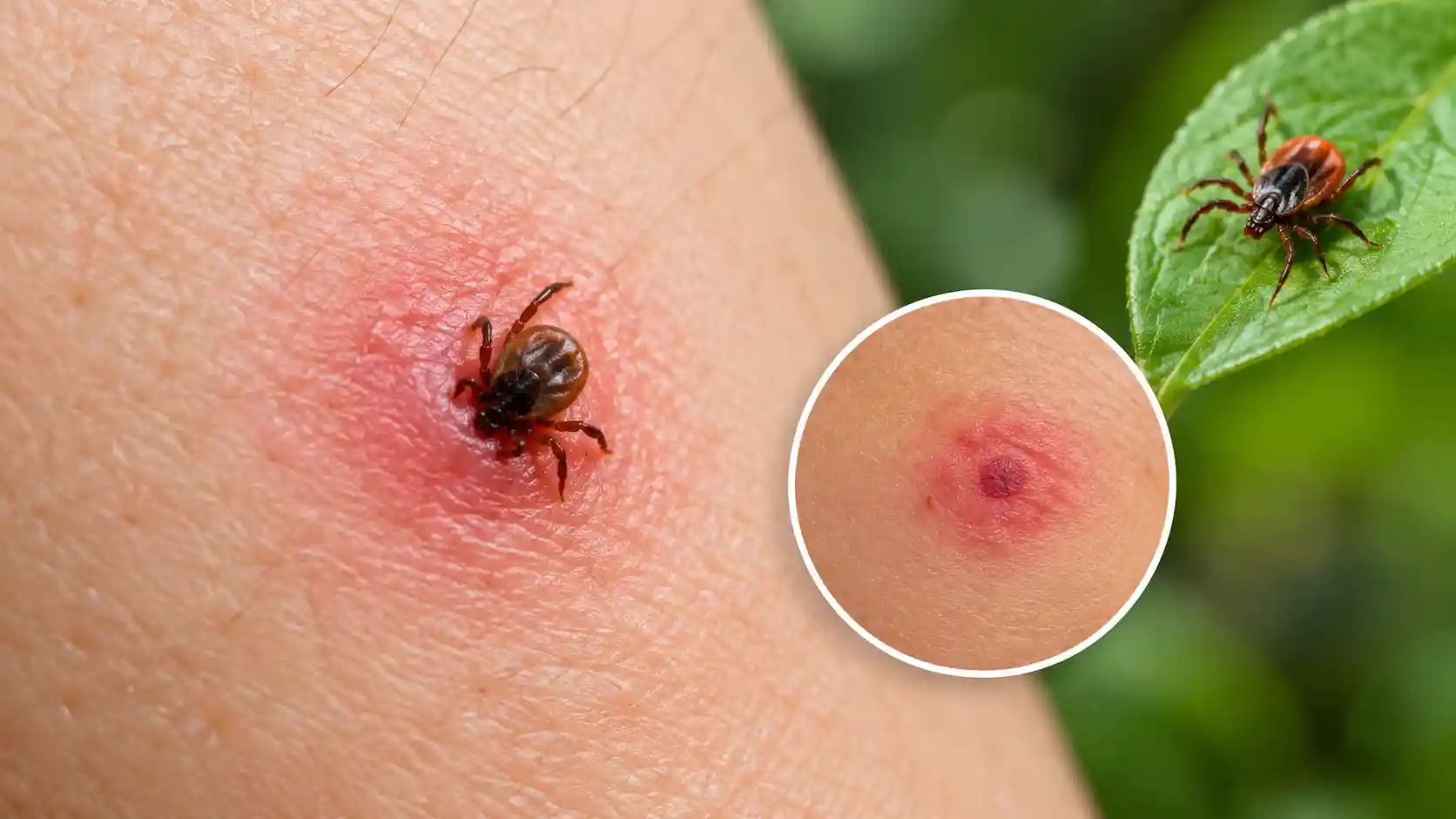
Finding a small red mark after spending time outdoors can immediately raise questions, especially in Massachusetts, where ticks are a familiar concern. So, what does a tick bite look like? In many cases, the first sign is a small red bump or area of mild irritation where the tick attached. It may resemble a mosquito bite and can disappear within a day or two.
The appearance alone, however, cannot always tell you whether a tick transmitted an infection. Some people never notice the original bite, and a Lyme disease rash can develop days later. Other tick-borne illnesses may cause fever, fatigue, headache, or muscle aches without producing a distinctive skin reaction.
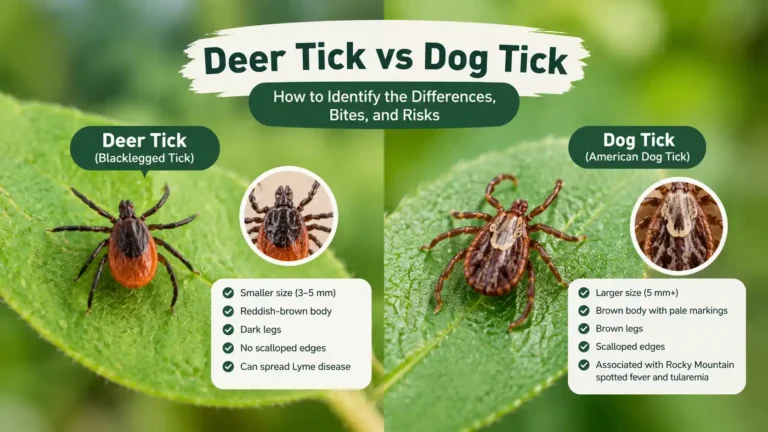
This matters for people in Weston because black-legged ticks, also called deer ticks, occur throughout Massachusetts. These ticks can transmit Lyme disease, babesiosis, anaplasmosis, Borrelia miyamotoi infection, and Powassan virus. Massachusetts also has American dog ticks, while lone star ticks occur in some areas of the state.
Knowing what to watch for, removing attached ticks promptly, monitoring symptoms, and reducing tick activity around your property can all help lower your risk.
What Does a Tick Bite Look Like at First?
People wondering what does a tick bite look like on a human should know that there is no single appearance that identifies every bite.
Immediately after a tick detaches or is removed, you may notice:
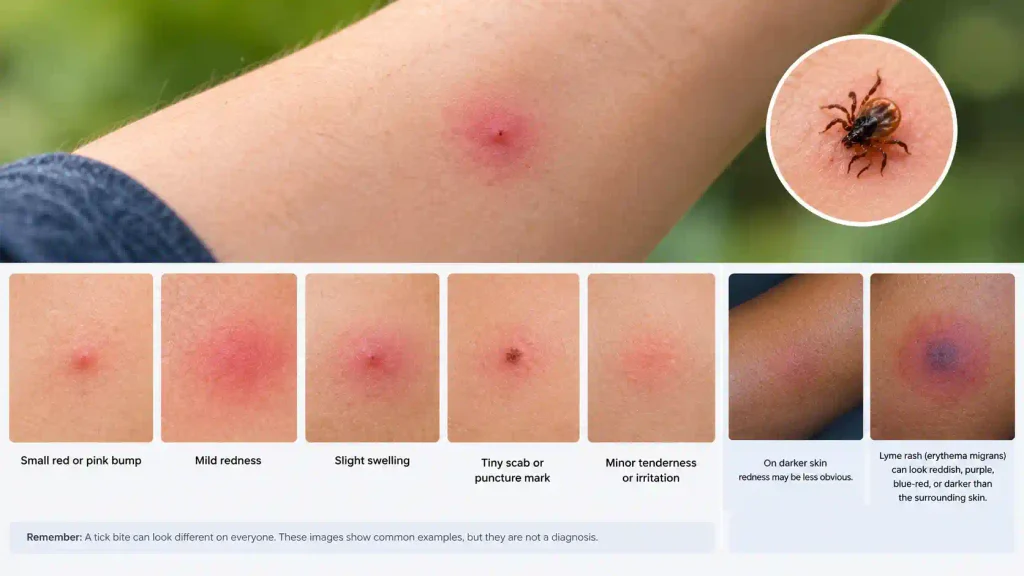
- A small red or pink bump
- Mild localized redness
- Slight swelling
- A tiny scab or puncture mark
- Minor tenderness or irritation
According to the CDC, a small bump or redness that develops immediately and resembles a mosquito bite is common after a tick bite. This type of irritation generally disappears within one or two days and, by itself, is not considered evidence of Lyme disease.
Searching online for tick bite pictures can provide useful visual context, but photographs cannot diagnose Lyme disease or another tick-borne infection. Lighting, skin tone, scratching, allergic reactions, and the location of the bite can substantially change how a mark appears.
On darker skin, redness may also appear less obvious. An erythema migrans rash associated with Lyme disease can look reddish, purple, blue-red, or simply darker than the surrounding skin rather than appearing bright red. The CDC specifically notes that Lyme rashes can vary considerably in appearance and do not always form the classic target pattern.
Tick Bite Timeline: Day 1 to Week 2
Understanding timing can be more useful than judging the mark from a single photograph.
Day 0–1: The Tick Is Attached or Has Just Been Removed
A tick may remain attached while feeding for hours or even days. An engorged tick can become noticeably larger after taking a blood meal.
After removal, the skin may show minor localized inflammation. These early signs of a tick bite do not automatically mean disease transmission occurred.
Day 1–2: Mild Local Reaction
A small irritated spot may remain temporarily. Mild redness that stays close to the bite and begins improving is generally more consistent with a local skin reaction than with erythema migrans. This is also a good time to record the date, photograph the area, and note where on the body the tick was found.
Day 3–7: Continue Monitoring
Some Lyme disease symptoms can start during this period. The characteristic erythema migrans rash can begin between 3 and 30 days after an infected tick bite, with an average onset of about seven days according to the CDC.Watch for an area that gradually expands rather than remaining a tiny, stable bump.
Week 1–2: Watch for Systemic Symptoms
Some tick-borne illnesses may begin with symptoms that resemble a viral illness. Depending on the disease, possible tick bite symptoms include fever, chills, fatigue, headache, muscle aches, joint discomfort, or swollen lymph nodes.Anaplasmosis commonly produces fever, headache, chills, muscle aches, and fatigue, with symptoms typically developing within one to two weeks.Babesiosis can produce fever, chills, fatigue, headache, abdominal discomfort, and other symptoms, although some infected people experience few or no symptoms.
Normal Reaction vs. Concerning Signs
A normal local reaction is usually small, limited to the bite area, and improves rather than steadily expanding.
More concerning changes include:
- An expanding circular or oval rash
- Redness that continues getting larger
- Fever or chills
- Severe fatigue
- Headache
- Muscle or joint pain
- Swollen lymph nodes
- Facial weakness
- Dizziness or shortness of breath
- New neurological symptoms
- Increasing warmth, swelling, drainage, or significant pain around the wound
A common question is do tick bites itch. A minor local reaction may itch, but the erythema migrans rash associated with Lyme disease is typically not very itchy or painful. CDC guidance says it may feel warm but is rarely itchy or painful.
Knowing how to tell if a tick bit you can be difficult when the tick is no longer present. A visible attached tick provides the clearest evidence. Otherwise, consider recent exposure to wooded, grassy, brushy, or leaf-covered areas and monitor unexplained skin changes and symptoms.
The Bullseye Rash (Erythema Migrans) Explained
The best-known Lyme disease skin finding is the bullseye rash, medically called erythema migrans or EM.
It often begins near the attachment site and gradually expands over several days. Some lesions develop lighter skin toward the center, creating the familiar target appearance.However, many EM rashes do not resemble a perfect target.
Someone asking what does a lyme disease rash look like should therefore focus on progressive expansion rather than expecting a textbook ring. CDC examples include uniformly expanding lesions, lesions without central clearing, reddish-blue areas, target-shaped patterns, and rashes with central crusting.
The rash can appear anywhere on the body and may eventually become quite large. CDC guidance states that EM occurs in approximately 70%–80% of infected people, meaning the absence of a recognizable rash does not rule out Lyme disease.
If you develop an expanding rash after possible tick exposure, contact a healthcare professional rather than waiting for it to develop a textbook appearance.
What Does an Infected Tick Bite Look Like?
People frequently search what does an infected tick bite look like, but two different issues can be involved: a localized skin infection at the bite site or an illness transmitted by the tick.
A local bacterial skin infection may cause increasing pain, warmth, swelling, tenderness, or drainage. By contrast, Lyme disease may cause an expanding EM rash and flu-like symptoms. The appearance of the bite itself cannot reliably determine whether the tick carried a disease-causing organism.That is why monitoring your overall health after a bite is important.
How Long Does the Initial Bump Last?
If you are wondering how long does a tick bite bump last, a minor irritation from the bite often settles within about one or two days. CDC guidance distinguishes this short-lived local reaction from an EM rash, which develops later and expands.
A mark that persists does not automatically mean Lyme disease. However, contact a healthcare provider if the area continues expanding, becomes increasingly painful, develops drainage, or appears alongside fever or other concerning symptoms. Another common question is do tick bites hurt. Many do not. Some people only notice the tick because they see it attached to the skin.
Tick Bite vs. Other Bug Bites
The tick bite vs mosquito bite comparison can be confusing because both can initially produce a small reddish bump.
A mosquito bite commonly becomes itchy fairly quickly and may form a raised welt. A simple tick attachment site may remain small and mildly irritated.
Lyme disease changes the comparison because the EM rash usually appears several days after the bite and progressively expands. It is generally not intensely itchy.
Bed bug bites commonly appear in clusters or lines, while flea bites are often small and grouped around the lower legs or ankles. Many skin conditions can mimic insect bites, so appearance should not be used as the sole basis for diagnosing an infection.
Tick Species in Massachusetts — and What Their Bites Mean
Massachusetts residents may encounter several important tick species.
Black-Legged Tick
The black-legged tick is particularly important in Weston and across Massachusetts because it can transmit multiple pathogens.
Massachusetts public health guidance identifies it as a vector for:
- Lyme disease
- Babesiosis
- Anaplasmosis
- Borrelia miyamotoi
- Powassan virus
Both adult and nymph ticks bite people. A nymph tick can be approximately the size of a poppy seed, which makes it especially easy to overlook.
American Dog Tick
The American dog tick is also found throughout Massachusetts. Adult dog ticks can bite humans and may transmit organisms associated with Rocky Mountain spotted fever and tularemia.
Lone Star Tick
The lone star tick is found in some parts of Massachusetts. State guidance notes that it can transmit illnesses including ehrlichiosis and tularemia and is associated with southern tick-associated rash illness. Alpha-gal syndrome is also an emerging concern associated with this species.
Where Do Ticks Bite on the Body Most Often?
Parents, hikers, pet owners, and gardeners often ask where do ticks bite on the body most often because ticks prefer protected areas where they can remain unnoticed.
Check carefully around:
- The hairline and scalp
- Behind the ears
- Under the arms
- Around the waist
- Behind the knees
- Between the legs
- Around the groin
- Inside or around the belly button
- Along clothing lines
Massachusetts officials specifically recommend checking concealed areas including underarms, behind the knees, behind the ears, and near the hairline after outdoor activities. Children may need help checking their scalp, neck, ears, back, and other difficult-to-see areas.
Can You Feel a Tick Bite?
If you are asking can you feel a tick bite, the answer is often no. An attached tick may remain unnoticed because the bite itself may not produce an obvious sensation.That is why visual tick checks are important even when you do not feel anything unusual.
After gardening, hiking, playing outdoors, working near brush, or spending time around wooded property edges, check yourself rather than relying on itching or pain to alert you.
How Long After a Bite Do Symptoms Start?
Symptom timing depends on the disease.
For Lyme disease, early symptoms can begin 3–30 days after an infected tick bite. These may include fever, chills, headache, fatigue, muscle aches, joint aches, swollen lymph nodes, or erythema migrans.Anaplasmosis symptoms often develop within approximately one to two weeks.
Babesiosis can have a more variable course, and some infected people develop little or no noticeable illness.Because symptoms may appear after the original bite mark has disappeared, remembering the exposure date can help when speaking with a healthcare professional.
Tick-Borne Diseases in Massachusetts to Know About
Tick-borne illness is not a theoretical concern in Massachusetts.The Massachusetts Department of Public Health states that the most common tick-borne diseases in the state are Lyme disease, babesiosis, and anaplasmosis. Other reported infections include Borrelia miyamotoi disease, Powassan virus, tularemia, and Rocky Mountain spotted fever.
Massachusetts surveillance data continue to document thousands of tick-borne disease cases. State data current through September 30, 2026 reported 5,269 Lyme disease cases, 602 babesiosis cases, and 1,194 human granulocytic anaplasmosis cases for 2026 year-to-date, although the state notes these figures are preliminary and subject to change.
A major misconception is do all tick bites cause lyme disease. They do not. Lyme disease requires the bite of an infected black-legged tick, and not every tick carries the bacteria. Still, every attached tick deserves attention because Massachusetts ticks can transmit several illnesses.
How to Remove a Tick Safely
Knowing how to remove a tick safely is one of the most useful steps you can take after finding one attached.
The CDC recommends removing the tick promptly instead of waiting for a healthcare professional to do it. Delaying removal can increase the opportunity for disease transmission.
Use these steps:
- Use clean, fine-tipped tweezers.
- Grasp the tick as close to the skin surface as possible.
- Avoid squeezing the tick’s swollen body.
- Pull upward with steady, even pressure.
- Do not twist or jerk the tick.
- After removal, clean the bite area and your hands.
- Photograph or preserve the tick if identification may be useful.
- Record the date and location of the bite.
If mouthparts remain embedded, do not aggressively dig into the skin. If they cannot be removed easily, allow the skin to heal and seek medical advice if significant irritation develops.
Avoid attempting to make the tick detach with heat, petroleum jelly, nail polish, or similar methods. Prompt mechanical removal is preferred. Rubbing alcohol can be used as part of cleaning after removal, but it should not replace proper mechanical removal.
What to Do After a Tick Bite
Once the tick is removed, a few simple actions make future monitoring much easier.
Photograph the tick before disposing of it, especially if you are uncertain about the species. Consider placing it in a sealed container or bag temporarily if a healthcare provider or tick identification service may need to examine it.
Massachusetts provides information about tick identification and testing services. Testing a tick, however, should not substitute for medical evaluation when symptoms develop.
Write down:
- The date the tick was discovered
- The part of the body where it was attached
- Where you may have encountered it
- Whether it appeared flat or engorged
- How long it might have been attached
Continue observing the bite area and your general health during the following several weeks.
When to See a Doctor
Knowing when to see a doctor for a tick bite is especially important in a state where multiple tick-borne illnesses occur.
Contact a healthcare professional if you develop an expanding rash, fever, chills, unexplained fatigue, persistent headache, muscle aches, joint pain, swollen lymph nodes, facial weakness, or other new symptoms after a tick bite or likely tick exposure.
The CDC advises seeking medical care if a rash or fever develops within several days to weeks after removing a tick. Seek urgent medical care for severe symptoms such as difficulty breathing, fainting, significant neurological changes, severe weakness, or other rapidly worsening symptoms. Do not wait for a target-shaped rash before asking for medical advice if you feel unwell after possible exposure.
How to Check Yourself, Kids, and Pets for Ticks
A daily tick check can make a meaningful difference for families who regularly spend time outside.
After returning indoors, inspect exposed and covered areas of the body. Use a mirror for areas you cannot easily see and help children check their scalp, ears, neck, waistline, armpits, behind the knees, and groin.
Pets should also be checked after spending time outdoors because ticks can attach to animals or be carried closer to household living areas.
Outdoor precautions can include EPA-registered repellents containing ingredients such as DEET when used according to label directions. Permethrin-treated clothing and gear can also be part of a prevention strategy when used correctly.
Massachusetts recommends protective clothing, appropriate insect repellent, and thorough tick checks after time in wooded or grassy areas.
Reducing Ticks Around Your Weston, MA Home and Yard
Personal protection matters, but reducing the places where ticks thrive around a property can address the problem closer to its source.
Ticks favor shady, moist environments, leaf litter, brush, tall grass, wooded edges, and areas frequently used by wildlife. Massachusetts public health guidance specifically notes that ticks are commonly found in shady, damp, brushy, wooded, and grassy areas—including residential yards.
For homeowners in Weston, practical yard management can include keeping frequently used areas maintained, clearing unnecessary leaf litter, reducing dense brush along property edges, trimming overgrown vegetation, and paying particular attention to transitions between lawns and wooded areas. Move children’s play equipment and frequently used seating areas away from brushy boundaries when practical.
A professional tick yard treatment can also be considered when tick activity remains persistent, a property borders wooded habitat, family members or pets regularly encounter ticks, or homeowners want a more structured prevention program.
Residents looking for a local starting point can visit Tick Control Weston MA to learn about property-focused tick management.
Why Tick Prevention Matters in Weston
Massachusetts experiences tick activity beyond just the middle of summer.State reports note that tick activity and tick-borne disease occur year-round, although activity depends on weather. Massachusetts generally experiences one activity peak beginning around March or April and continuing through August, followed by another peak around October and November.Black-legged adult ticks can also be active on winter days when temperatures rise above freezing.
That makes tick prevention an ongoing property-management issue rather than something homeowners should consider only during July and August. A combination of personal precautions, regular tick checks, landscape management, repellents, pet protection recommended by a veterinarian, and professionally targeted treatment can reduce exposure opportunities.
If wooded edges, leaf litter, deer traffic, brush, or repeated tick encounters are affecting how comfortably your family uses the yard, you can Choose Tick Control Weston MA as part of a broader prevention strategy.
Frequently Asked Questions
1. Can a tick bite look like a mosquito bite?
Yes. A small localized red bump immediately after a tick is removed can resemble a mosquito bite. The CDC notes that this minor irritation commonly disappears within one or two days. A Lyme EM rash is different because it usually develops after a delay and gradually expands.
2. Does every Lyme rash have a target pattern?
No. Erythema migrans can be uniformly reddish, oval, circular, reddish-blue, darker than the surrounding skin, or have limited central clearing. The classic target appearance is only one possible presentation.
3. Can Lyme disease develop without a visible rash?
Yes. Not everyone with Lyme disease develops a recognized EM rash. CDC data indicate that approximately 70%–80% of infected people develop the rash, so other symptoms and exposure history also matter.
4. Should I save a tick after removing it?
Taking a clear photograph and temporarily keeping the tick in a sealed container can help with identification if necessary. Massachusetts provides resources related to tick identification and testing, but medical decisions should be made with a qualified healthcare professional rather than relying only on a tick test.
5. Are tiny ticks less important than large ticks?
No. A nymph tick can be extremely small and easy to miss. Massachusetts notes that black-legged nymphs may be approximately the size of a poppy seed, yet they can bite humans and transmit disease-causing organisms.
6. What should I do if I keep finding ticks in my yard?
Repeated encounters can indicate that your landscape provides favorable tick habitat or receives significant wildlife traffic. Reduce leaf litter and brush, maintain heavily used areas, perform daily checks after outdoor activity, and consider a property assessment or targeted control plan when the problem persists.
Final Thoughts
Most tick bites do not mean that a person will develop Lyme disease, but recognizing changes early can help you respond appropriately.
A small temporary red mark immediately after removal is common. An expanding rash, fever, headache, fatigue, muscle aches, joint discomfort, or other new symptoms deserve more attention, particularly after exposure in Massachusetts. Remove attached ticks promptly with fine-tipped tweezers, record the exposure, watch for symptoms during the following weeks, and contact a medical professional when concerning changes develop.
Prevention also extends beyond the bite itself. Daily checks, protective clothing, DEET-based insect repellent when appropriate, permethrin-treated clothing, landscape maintenance, and targeted property management can reduce opportunities for future exposure. For homeowners dealing with repeated tick encounters around lawns, wooded borders, family recreation areas, or pet spaces, Contact Tick Control Weston MA to explore options for reducing tick activity around the property.
2 Comments