
Deer Tick vs Dog Tick: How to Identify the Differences, Bites, and Risks
Finding a tick on your skin, your dog, or somewhere around your yard can raise an immediate question: Is it a deer tick or a dog tick? Although both are blood-feeding parasites, they differ in size, markings, preferred habitats, and the diseases they can transmit.
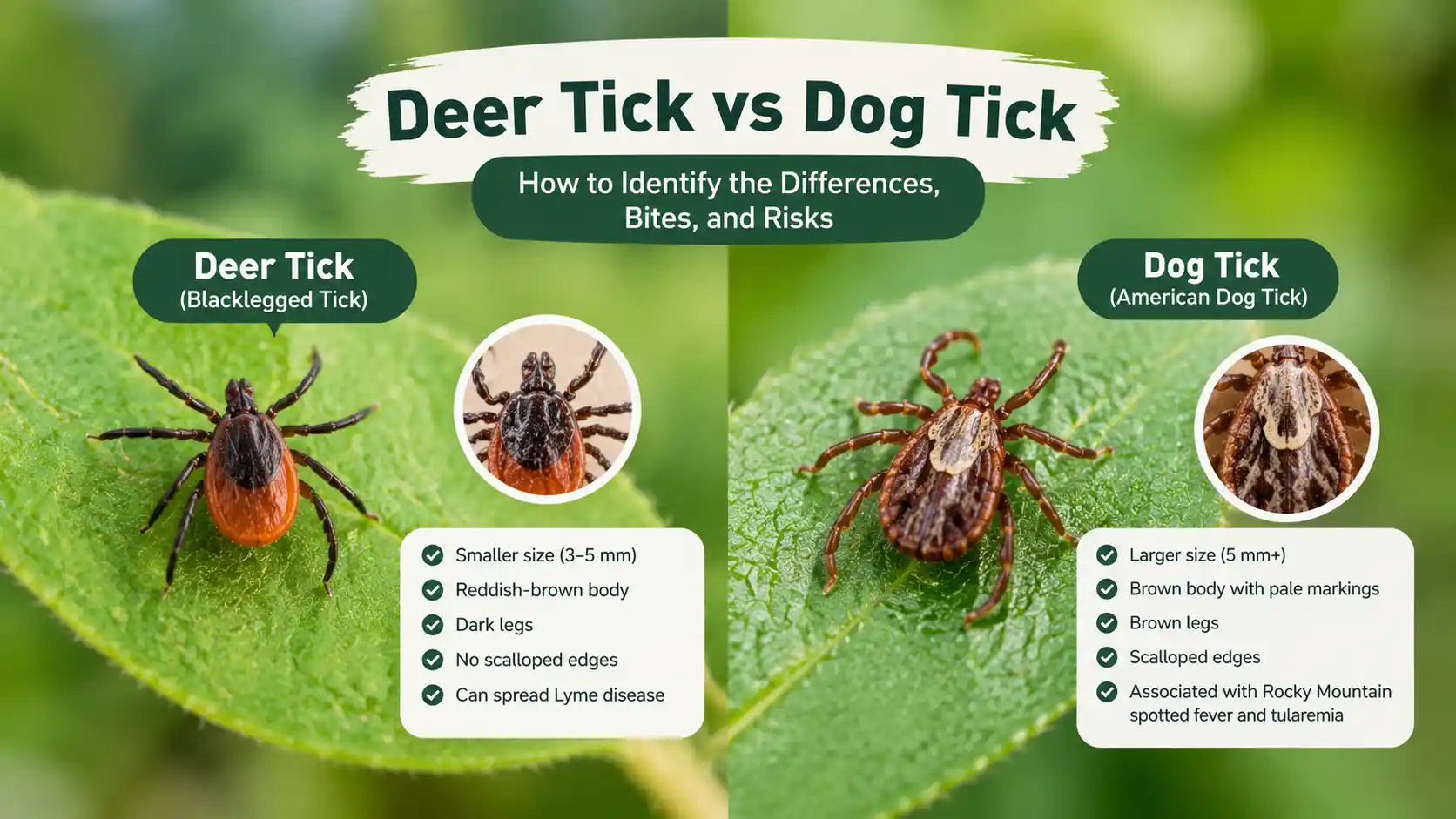
The main difference in a deer tick vs dog tick comparison is their appearance and health risks. Adult deer ticks are generally smaller, with dark legs and a reddish-brown body in females. American dog ticks are larger as adults and have distinctive pale markings on their backs. Deer ticks can spread Lyme disease, while American dog ticks are associated with Rocky Mountain spotted fever and tularemia.
For homeowners in Weston, Massachusetts, understanding these differences is especially useful because both types are found in the state. This guide explains how to identify each tick, recognize potential bite-related symptoms, remove attached ticks safely, and reduce tick exposure around your home.
Deer Tick vs Dog Tick: Quick Comparison
Before examining a tick closely, it helps to understand its most recognizable features. Both species belong to the group of hard ticks, but their physical characteristics are different.
| Feature | Deer Tick | American Dog Tick |
| Scientific name | Ixodes scapularis | Dermacentor variabilis |
| Common name | Blacklegged tick | American dog tick |
| Adult size | Approximately 3–5 mm when unfed | Approximately 5 mm or larger when unfed |
| Adult female appearance | Reddish-brown body with dark shield | Brown body with a pale patterned shield |
| Legs | Usually dark | Usually brown |
| Mouthparts | Relatively long | Relatively short |
| Festoons | Absent | Present |
| Preferred habitat | Woodlands, leaf litter, brushy edges | Grassy areas, fields, trails, and vegetation |
| Important disease risks | Lyme disease, anaplasmosis, babesiosis, others | Rocky Mountain spotted fever and tularemia |
| Found in Massachusetts | Yes | Yes |
These are general characteristics of unfed ticks. Appearance changes with sex, life stage, and feeding status.
The most reliable visual clues include the patterned shield, body shape, mouthparts, and small structures along the rear edge of the body. When identification is uncertain, a qualified tick identification service may help.
What Does a Deer Tick Look Like?
A Deer Tick, also called a Blacklegged Tick, is a small arachnid scientifically known as Ixodes scapularis. It is common in the Eastern United States, including Massachusetts.
Adult deer ticks are relatively small and easy to overlook, particularly when they are moving through clothing, pet fur, or vegetation.
Deer Tick Size, Color, and Body Features
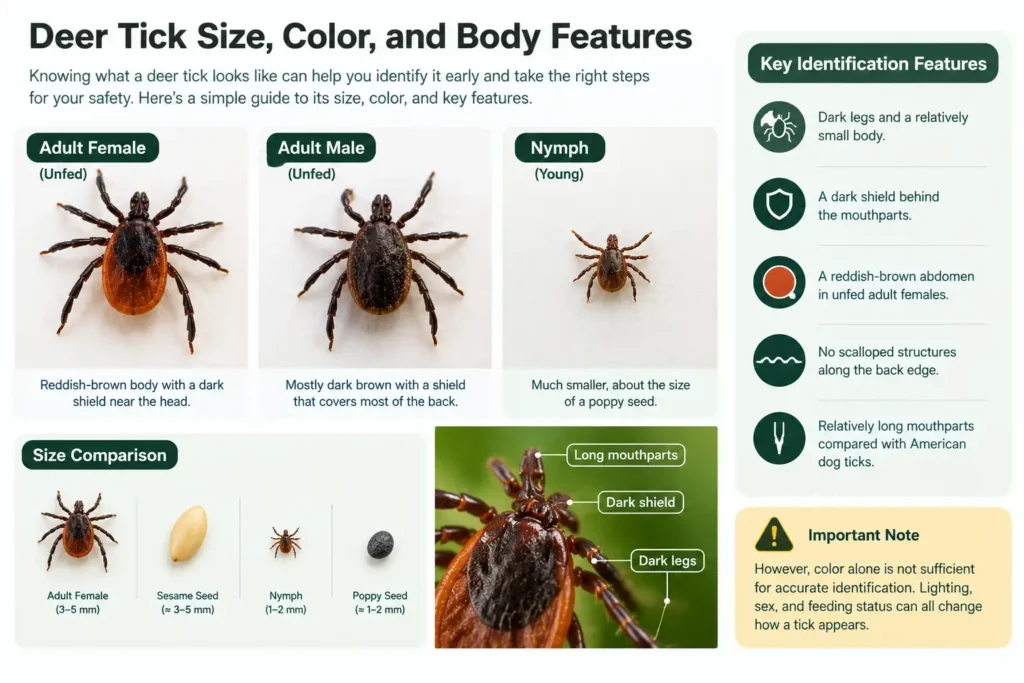
An unfed adult female deer tick is approximately the size of a Sesame Seed. Its body typically has a reddish-orange or reddish-brown section behind a dark shield near the head.
Its legs are usually very dark, sometimes appearing almost black. That characteristic explains the name blacklegged tick.Adult males look different from females. Their backs are mostly dark brown, and their shields cover almost the entire upper body.
Young deer ticks are even smaller. Nymphs can be approximately the size of a poppy seed, making them particularly difficult to notice during outdoor activities.
Important identification features include:
- Dark legs and a relatively small body.
- A dark shield behind the mouthparts.
- A reddish-brown abdomen in unfed adult females.
- No scalloped structures along the back edge.
- Relatively long mouthparts compared with American dog ticks.
However, color alone is not sufficient for accurate identification. Lighting, sex, and feeding status can significantly change how a tick appears.
Male vs. Female Deer Ticks
Female deer ticks have a distinctive two-tone appearance before feeding. Their dark shield occupies the front portion of the back, while the reddish abdomen remains visible.
Male deer ticks are often darker overall because their hard shield covers most of their upper body. They are generally less likely than adult females to be noticed feeding on people.
Both sexes have eight legs as adults, but their body patterns differ.
During deer tick identification, focus on the overall body structure rather than relying entirely on color.
Why Deer Tick Nymphs Are Difficult to Find
Deer ticks have four main developmental stages: egg, larva, nymph, and adult.Larvae have six legs, while nymphs and adults have eight.
Nymphs are especially important from a health perspective because their very small size makes them easy to miss. A person may not notice an attached nymph until it has already fed.This is one reason regular tick checks matter, even when no insects or pests are immediately visible on the skin.
What Does an American Dog Tick Look Like?
The Dog Tick most often discussed in comparisons with deer ticks is the American dog tick, scientifically known as Dermacentor variabilis.It is generally larger as an adult and has more noticeable markings than the blacklegged tick.American dog ticks can attach to dogs, people, and other mammals. Despite the name, they are not limited to dogs.
Dog Tick Size, Color, and Markings
An unfed adult American dog tick is often described as approximately the size of a watermelon seed. Its broader body makes it easier to notice than a small deer tick nymph.
The body is typically Dark Brown to reddish-brown with characteristic Light-Colored Markings.These pale or silvery markings are among the most useful identification clues.
The shield, called the scutum, sits behind the mouthparts. In adult females, this shield has a noticeable light-colored pattern, while the remaining abdomen is darker and expands during feeding.The lower rear edge of the body also contains small divisions that help distinguish this species from deer ticks.
Male vs. Female American Dog Ticks
Male Dog Ticks usually have pale patterns spread across much of the upper body because their hard shield covers most of the back.
Female Dog Ticks have a smaller patterned shield toward the front, with a darker abdomen behind it.A female’s abdomen can expand considerably after feeding, while the hard shield does not expand in the same way.
This distinction matters because an engorged female may look very different from the unfed examples shown in identification guides.For accurate dog tick identification, check the markings and body structures together.
American Dog Tick vs. Brown Dog Tick
Not every tick found on a dog is an American dog tick.The brown dog tick, Rhipicephalus sanguineus, is a separate species that can infest kennels and indoor areas where dogs live.American dog ticks are more commonly associated with outdoor grassy and brushy environments.Brown dog ticks generally lack the American dog tick’s distinctive pale patterned shield.
If ticks are repeatedly appearing indoors, especially around dog bedding and resting areas, the problem may require a different type of investigation than an outdoor tick exposure.
How to Tell the Difference Between a Deer Tick and a Dog Tick
The american dog tick vs deer tick comparison becomes easier when you examine multiple identifying features rather than relying on a single characteristic.
Deer Tick vs Dog Tick Size
The phrase deer tick vs dog tick size refers to one of the most noticeable differences between adult ticks.
An unfed adult deer tick is usually around 3–5 millimeters long. American dog tick adults are typically larger and may measure approximately 5 millimeters or more, depending on their sex and feeding status.
A very small deer tick nymph may be barely visible without careful inspection.Some people compare the appearance of an engorged tick to a Pencil Eraser, but that is not a reliable size reference for an unfed tick.Size comparisons should always account for developmental stage and whether the tick has recently fed.
For example, an engorged deer tick may be larger than an unfed American dog tick. Therefore, the larger tick is not automatically a dog tick.
Look at the Shield and Color Patterns
The hard shield behind the mouthparts is one of the most useful features for distinguishing these two species.
Adult female deer ticks usually have a dark, unpatterned shield with a reddish-brown abdomen.Female American dog ticks typically have cream-colored or silvery patterns on the shield.Adult males look different because their shields cover more of their backs.When examining a tick, use good lighting and avoid squeezing its body.
Check the Mouthparts and Festoons
Festoons are small divisions along the rear edge of the body of certain hard tick species.These divisions can appear as tiny Ridges or scalloped sections when viewed closely.American dog ticks have festoons, while deer ticks do not.This distinction may be easier to see under magnification than with the naked eye.
The mouthparts also differ. Deer ticks generally have longer mouthparts relative to their bodies, while American dog ticks have shorter ones.These anatomical features can help when other characteristics are unclear.
Engorged Deer Tick vs Dog Tick: What Changes After Feeding?
An engorged deer tick vs dog tick comparison can be more challenging than identifying unfed ticks.
Engorged Ticks have consumed blood, causing their abdomens to expand. As feeding continues, their bodies may become rounded, swollen, grayish, or tan.A fully engorged female deer tick may look dramatically different from the small, reddish-brown tick shown in educational images.
An engorged female American dog tick can also become much larger and lose some of its original color contrast.The shield remains relatively unchanged in size, but the expanding abdomen can make it harder to see.
If you find an engorged tick:
- Remove it promptly if it is attached.
- Avoid crushing the body.
- Photograph it if identification is important.
- Record when and where you found it.
- Contact a healthcare professional if symptoms develop or exposure concerns warrant an assessment.
Do not delay removal while trying to determine the exact species.
Deer Tick vs Dog Tick Pictures: What Should You Look For?
Comparing accurate, clearly labeled deer tick vs dog tick pictures is one of the most practical ways to understand their differences.
However, photographs can be misleading when ticks are shown at different magnifications.A large close-up image of a deer tick may make it look bigger than a dog tick in another photograph.
When using identification pictures, look for these details:
- Whether both ticks are shown at the same scale.
- Whether they are males or females.
- Whether they have recently fed.
- The shape and color of the shield.
- The presence or absence of festoons.
- The relative length of the mouthparts.
Images showing female adult ticks side by side are especially useful for beginners because their markings are more distinctive.The Massachusetts Department of Public Health provides educational identification materials showing deer ticks and American dog ticks at different life stages.For identification assistance, consult its official tick identification resources rather than relying on an unlabeled social media photograph.
Deer Tick vs Dog Tick Bite: Are the Symptoms Different?
A deer tick vs dog tick bite cannot usually be distinguished by examining the skin alone.
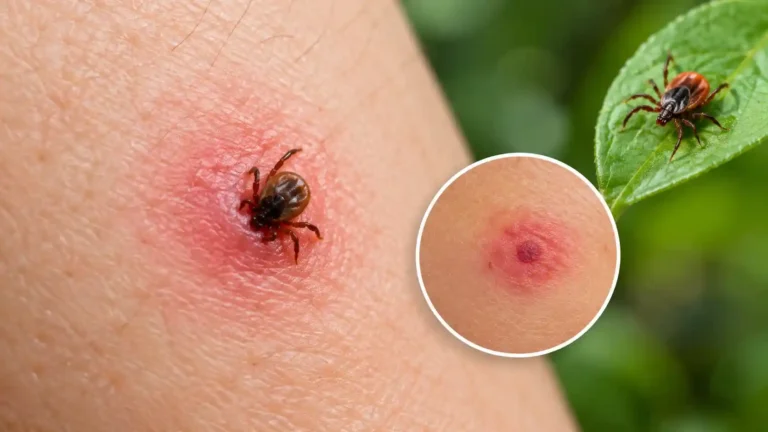
Both ticks attach to the skin and feed on blood. Their bites may leave a small red spot, mild irritation, or little visible evidence.A tick’s saliva contains substances that help it feed, and people can react differently to these substances.Some individuals develop localized redness or itching. Others may not notice the bite at all.
What Does a Tick Bite Look Like?
A Tick Bite may appear as a small red bump or irritated spot.A minor reaction around the attachment point does not automatically indicate an infection.However, a spreading Rash, fever, headache, fatigue, or other symptoms after potential tick exposure deserve medical attention.
A Lyme disease rash may gradually expand, and it does not always have the classic bull’s-eye appearance.The absence of a rash also does not rule out tickborne illness.For additional information, see our related guide on what a tick bite looks like.
Can You Identify the Tick From the Bite Mark?
No. The appearance of a bite generally does not reveal which tick species caused it.The most useful evidence is the actual tick, if it is still available, along with the geographical location, exposure history, and any developing symptoms.Photographs can help with identification, but the tick should be examined carefully.If you become ill, tell your healthcare provider when you may have been exposed and whether you removed an attached tick.
Which Ticks Carry Lyme Disease and Other Illnesses?
Many homeowners ask which ticks carry Lyme disease because infection risks are often their greatest concern.
In Massachusetts, the blacklegged or deer tick is the established vector of the bacteria responsible for Lyme disease.American dog ticks are not recognized as vectors of Lyme disease, although they can transmit other disease-causing organisms.
Deer Ticks and Lyme Disease
Lyme Disease is a bacterial infection most commonly caused in the northeastern United States by Borrelia burgdorferi.
The infection spreads to humans through the bite of an infected blacklegged tick.Not every deer tick carries the bacteria, and not every bite results in infection.Possible symptoms include fever, fatigue, headache, muscle aches, and an expanding rash.If untreated, Lyme disease can sometimes affect the joints, Heart, and Nervous System.
The risk of Lyme disease transmission generally increases the longer an infected blacklegged tick remains attached. Other tickborne pathogens have different transmission timelines, so removing any attached tick promptly is important.
People with symptoms or concerns about an identified high-risk bite should contact a healthcare professional. In some circumstances, a clinician may recommend preventive antibiotic treatment after an eligible tick bite.
Other Diseases Spread by Deer Ticks
Blacklegged ticks can transmit several pathogens besides the bacteria responsible for Lyme disease.
In Massachusetts, important illnesses associated with deer ticks include:
- Anaplasmosis, a bacterial illness that can cause fever, headache, and muscle pain.
- Babesiosis, a parasitic infection affecting red blood cells.
- Borrelia miyamotoi disease, which may cause fever and other flu-like symptoms.
- Powassan virus disease, an uncommon but potentially serious viral infection.
The likelihood of encountering a particular pathogen varies with location, season, and other ecological factors.For this reason, it is important not to assume that Lyme disease is the only concern following a deer tick bite.
American Dog Ticks and Rocky Mountain Spotted Fever
Rocky Mountain Spotted Fever is a potentially serious bacterial illness associated with several tick species, including the American dog tick.
Despite the name, Rocky Mountain spotted fever can occur outside the Rocky Mountain region.Symptoms may include fever, headache, muscle pain, nausea, and rash.
The illness can progress rapidly and requires urgent medical evaluation when suspected. Treatment should not be delayed while waiting for laboratory confirmation.American dog ticks can also transmit certain forms of tularemia.
Although these illnesses are less common in Massachusetts than Lyme disease, they remain important reasons to prevent tick bites.
Which Tick Is More Dangerous?
Neither species should be considered harmless.Deer ticks are especially important in Massachusetts because of the diseases they can spread, including Lyme disease, anaplasmosis, and babesiosis.American dog ticks can also transmit serious illnesses.
The actual risk depends on the species, whether the tick carries a pathogen, the duration of attachment, and other factors.The safest response is to remove an attached tick quickly and monitor for symptoms rather than assuming one species is safe.
Where Are Deer Ticks and Dog Ticks Found?
Ticks depend on suitable habitat, available animal hosts, and environmental conditions.Both deer ticks and American dog ticks occur in Massachusetts, but they often favor somewhat different environments.
Common Deer Tick Habitats
Deer ticks are commonly associated with shaded, moist environments where vegetation and fallen leaves provide protection from drying out.They may be found in wooded areas, brushy property boundaries, garden edges, and leaf-covered ground.
Their life cycle involves feeding on different animals.Deer are important hosts for adult blacklegged ticks, while small mammals help support immature stages.Mice are particularly important in the ecology of Lyme disease because some can carry the bacteria that infect feeding ticks.Birds and other animals can transport ticks between different habitats.
Where American Dog Ticks Live
American dog ticks are commonly associated with grassy environments, open fields, trails, and areas with suitable animal hosts.
They may wait on vegetation for passing animals or people.Wildlife, including various mammals, supports tick populations. Other animals, such as Squirrels, may also serve as hosts for some ticks.Because ticks can use multiple animal hosts, their presence does not necessarily mean a property has a large deer population.Residential yards near wooded or grassy areas can still offer suitable tick habitat.
Tick Season in Weston, Massachusetts
Tick exposure in Massachusetts is not limited to summer.
Deer tick nymphs are especially important during warmer months, while adults can be active in spring and fall.Adult blacklegged ticks may also become active during winter periods when temperatures rise above freezing.American dog tick encounters are generally more common during spring and summer.Homeowners should continue outdoor checks whenever weather conditions allow tick activity, even outside what is traditionally considered peak tick season.
What Does a Deer Tick Look Like on a Dog?
If you are wondering what does a deer tick look like on a dog, the answer depends on the tick’s life stage and whether it has fed.
An unfed adult female deer tick may appear as a small, flat, reddish-brown oval with dark legs. A nymph may look like a tiny dark speck buried among the fur.After feeding, the abdomen becomes larger and more rounded.Ticks often attach where they can remain undisturbed. On dogs, carefully examine areas around the ears, eyelids, collar, tail, legs, and toes.
Can Deer Ticks Bite Dogs?
Yes. Deer ticks can attach to and feed on dogs.
Dogs can also develop certain tickborne infections, including Lyme disease.Some infected dogs show no obvious signs, while others may develop fever, lameness, or reduced activity.Contact a veterinarian if your dog appears ill after possible tick exposure.
How to Protect Pets From Ticks
Pets can encounter ticks while walking through yards, parks, trails, and wooded areas.
An effective prevention routine includes checking animals after outdoor activities and consulting a veterinarian about appropriate tick prevention products.
Never assume a repellent designed for humans is safe for animals.Some substances and products that are suitable for dogs can also be dangerous to cats.
Regular grooming and checking fur can help you find ticks before they remain attached for long periods.Remember that dogs can carry unattached ticks indoors, where those ticks may later attach to people.
How to Remove a Tick Safely
Knowing how to remove a tick safely is essential because prompt removal can reduce the risk of certain tickborne infections.
If you find an attached tick, remove it rather than waiting for it to detach naturally.
Step 1: Use Fine-Tipped Tweezers
Take clean, fine-tipped Tweezers and grasp the tick as close to the skin’s surface as possible.Try to grip near the mouthparts instead of squeezing the swollen abdomen.If fine-tipped tweezers are unavailable, do not delay removal unnecessarily.
Step 2: Pull With Steady Pressure
Pull the tick away from the skin using steady, even pressure.
Avoid twisting, jerking, or forcefully crushing the tick.Sudden movements can cause the mouthparts to break and remain in the skin.If small mouthparts remain and cannot be removed easily with clean tweezers, allow the skin to heal rather than digging into it.
Step 3: Clean the Skin
After removal, thoroughly clean the Bite Area and your hands with Soap and Water, rubbing alcohol, or another appropriate cleaning product.Dispose of the tick by sealing it in a container, wrapping it tightly in tape, placing it in alcohol, or flushing it down the toilet.If you wish to keep the tick for possible identification, store it securely.
Step 4: Watch for Symptoms
Record the date and approximate location of the bite.
Pay attention to new symptoms over the following weeks.Seek medical advice if you develop fever, rash, unusual fatigue, headache, or muscle aches after possible tick exposure.A clinician can assess whether additional evaluation or treatment is appropriate.
Tick Removal Mistakes to Avoid
Do not try to remove ticks by applying heat, petroleum jelly, nail polish, gasoline, or other irritating substances.
These methods do not offer a reliable alternative to physical removal and can cause harm.Do not squeeze an engorged tick with your fingers.Also, avoid using commercial tick testing results as the only basis for deciding whether medical treatment is necessary.
How to Prevent Ticks in Your Yard
Understanding how to prevent ticks in your yard is especially important for Weston homeowners with gardens, lawns, outdoor seating areas, or properties bordering woods.The goal is to reduce the conditions that support ticks and limit opportunities for people and animals to encounter them.No single method completely eliminates tick exposure.
Keep Grass and Vegetation Maintained
Regular lawn mowing and vegetation maintenance can reduce some favorable tick habitats.
Remove dense brush around frequently used areas, and prevent tall grass from spreading into walking paths or outdoor seating spaces.Ticks can still occur in maintained yards, so lawn care alone is not a complete prevention plan.
Remove Leaf Litter
Fallen leaves help create damp, sheltered conditions that may support blacklegged ticks.Clearing excessive leaf litter around recreation spaces, property edges, and landscaping features can help reduce suitable habitat.Pay particular attention to transitions between wooded areas and maintained lawns.
Create a Barrier Around Wooded Edges
A strip of wood chips or gravel between wooded vegetation and recreational lawn areas may help define a tick-conscious landscape.CDC guidance describes a three-foot-wide barrier as one landscaping option.Keep children’s play areas and frequently used outdoor furniture away from heavily vegetated property edges when practical.
Reduce Wildlife Attractants
Ticks rely on animal hosts throughout their lives.
Store trash securely, avoid leaving unnecessary food sources outdoors, and manage conditions that encourage unwanted rodents near structures.Keep stacked firewood in a neat, dry area.Wildlife management should remain lawful, practical, and appropriate for the property.Eliminating all wildlife is neither realistic nor necessary for a sensible tick management plan.
Protect Yourself During Outdoor Activities
Personal Tick Protection should complement landscape maintenance.
Use an EPA-registered insect repellent appropriate for your age and activity, following its label instructions.Wear long pants, closed shoes, and suitable clothing when walking through brushy or wooded environments.
Permethrin-treated clothing or gear may provide additional protection when used according to product directions. Permethrin clothing treatments should not be applied directly to skin.Check your body, children, clothing, and pets after spending time outdoors.Showering soon after returning indoors can also provide a useful opportunity to inspect for ticks.
When Should You Consider Professional Tick Control?
Professional Tick Pest Control may be worth considering when tick encounters remain frequent despite basic yard maintenance.
A professional service may help evaluate landscape conditions, identify potential tick habitats, and discuss control options appropriate for a particular property.Tick management is especially relevant for homes with wooded borders, outdoor gathering spaces, or regularly used play areas.
What Can Professional Yard Tick Treatments Do?
Where appropriate and lawfully applied, targeted outdoor tick treatments can reduce tick populations in treated areas.
However, pesticide applications should not be presented as a guarantee that a yard will become tick-free.The CDC recommends combining outdoor tick management with personal protection, landscape maintenance, and regular tick checks. An effective property strategy may involve a combination of habitat modification, education, and suitable control measures.
Tick Control for Weston, MA Properties
Homeowners in Weston often need to consider both human activity and surrounding landscapes when planning tick prevention. Properties with wooded edges, shaded vegetation, and regular outdoor use may benefit from a site-specific approach.
Tick Control Weston MA is a local tick control business serving the Weston, Massachusetts market. If you are noticing recurring tick activity around your yard, contact the business to discuss available tick control options and whether professional assistance is appropriate for your property.Professional yard management should complement, not replace, tick checks, veterinary prevention, and prompt removal of attached ticks.
Frequently Asked Questions
1. Are deer ticks smaller than dog ticks?
Generally, yes. Unfed adult deer ticks are usually smaller than adult American dog ticks. However, developmental stage and feeding status affect size, so size alone cannot reliably identify a tick.
2. Can an American dog tick transmit Lyme disease?
American dog ticks are not established vectors of Lyme disease. In Massachusetts, the blacklegged tick is the primary species responsible for transmitting the infection to people. American dog ticks can transmit other pathogens.
3. Can you identify a deer tick after it becomes engorged?
Sometimes. An engorged deer tick may retain useful anatomical features, including its shield and lack of festoons. However, feeding changes its shape and color, and professional identification may be needed.
4. Can deer ticks live in residential yards?
Yes. Deer ticks can occur in yards with suitable vegetation, leaf litter, shaded areas, and animal hosts. A yard does not need to be deep in the woods to have tick activity.
5. Can dogs bring deer ticks into the house?
Yes. Dogs can carry attached or unattached ticks indoors. Regular pet checks and veterinarian-recommended prevention products help reduce exposure.
6. How long can a deer tick remain attached?
Deer ticks can remain attached for several days while feeding. Attachment time varies by life stage and other conditions. Remove an attached tick promptly, because infection risk may increase with longer feeding, depending on the pathogen.
7. Do ticks remain active during the Massachusetts winter?
Yes, under some conditions. Adult blacklegged ticks may become active on warmer winter days when temperatures are above freezing. Tick checks remain worthwhile following potential exposure.
8. Can professional tick control completely eliminate ticks?
No responsible tick control program should promise complete elimination. Professional services may reduce tick populations in treated areas, but new ticks can arrive on animals, and outdoor exposure remains possible. Combining yard management with personal prevention is important.
Final Thoughts: Protecting Your Family and Yard From Ticks
Deer ticks and American dog ticks differ in appearance, size, markings, and the diseases they can transmit. Deer ticks are important vectors of Lyme disease and several other infections in Massachusetts, while American dog ticks are associated with different health risks.Learning to identify these pests, removing attached ticks promptly, checking pets, and maintaining outdoor spaces are practical steps toward reducing exposure.If you are dealing with repeated tick sightings around your Weston property, Tick Control Weston MA can be contacted to discuss your concerns and available tick control services.
Concerned About Ticks in Your Weston Yard?
Visit Tick Control Weston MA to find current contact information and inquire about tick control options for your property.
One Comment